Food for thought Book Review “The Prince and His Heirs”: What political success conceals in retrospect


By Sven Rawe
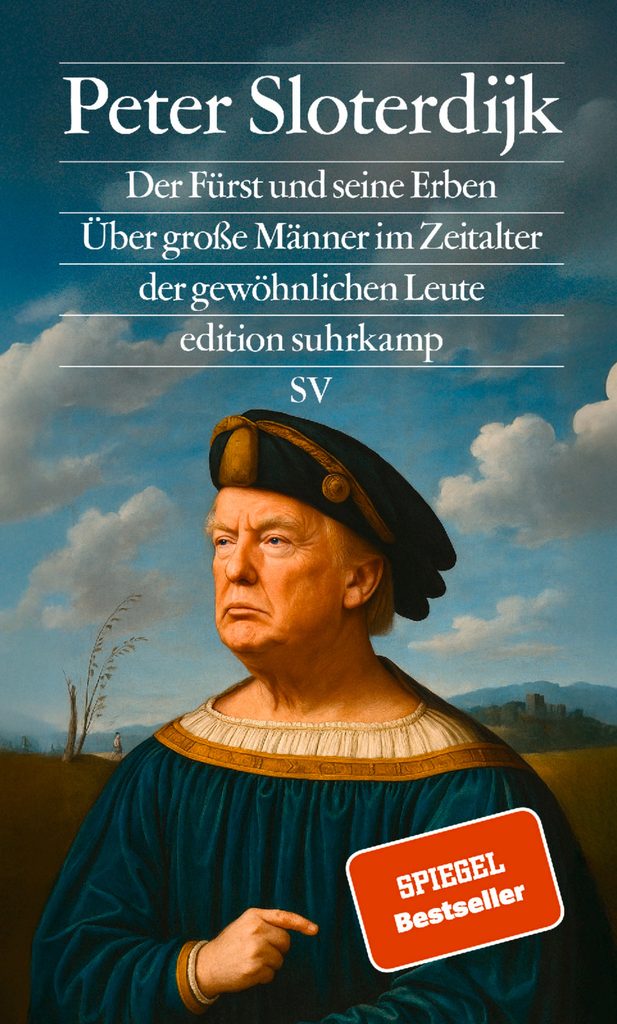
Those who drive political change can only partly determine the conditions under which they act. In hindsight, however, when a project has already succeeded, that success can easily appear as proof of personal ability. Peter Sloterdijk’s essay examines how rising political figures derive a special calling from their success.
In The Prince and His Heirs, Sloterdijk asks why, despite the end of the monarchy, political power continues to be embodied in individual figures. From his perspective, the transition to a republic does not resolve the issue of personal rule: in France, the execution of the king in 1793 was followed by the coronation of an emperor as early as 1804. In his eyes, today’s authoritarian rulers are the Heirs of the Prince. According to Sloterdijk, the tendency towards autocratic rule remains inherent in democracy. Regarding the rise to the top, he draws on Machiavelli’s virtù – the skill of those who act – which he describes today as competence or entrepreneurial energy. Whether this skill leads to success, he argues, depends on how well it aligns with fortuna: the changing circumstances with their favourable and unfavourable twists and turns.
Sloterdijk illustrates this relationship with the role of the broadcast: Without it, he argues, orators such as Hitler and Churchill would have only been able to spread their messages from the top of a vegetable crate at Speakers’ Corner in Hyde Park; it was the medium of the broadcast that provided them with an audience far beyond those in their immediate surroundings. In retrospect, this precondition can fade into the background of the person. According to Sloterdijk, those who have risen to prominence often find themselves compelled to deduce their mission from their success. He quotes from Nietzsche’s The Gay Science: ‘No victor believes in chance.’
Why it matters here: Sloterdijk’s case studies are predominantly authoritarian rulers; this book review applies one specific aspect of his analysis to individuals, teams and organisations that initiate political change: the way in which success is narrated in hindsight. His example is convincing because it juxtaposes two opponents: both made an impact with the help of the same precondition, regardless of how they utilised it. In the context of a political endeavour, this means that existing skills can only become effective under certain conditions. A change in majority can pave the way for a previously blocked reform proposal, without its proponents having suddenly become more competent.
Nietzsche’s statement also doubly applies to the concept of ‘opportunity’. A complete coincidence that led a plan to success can, in hindsight, easily become an opportunity that one saw coming, even though the success itself does not reveal whether that coincidence was recognisable as an opportunity in advance. Furthermore, what has been achieved appears as if it was bound to happen. Sloterdijk describes rulers who interpret their rise in this way and who declare differently minded people to be enemies within; for them, the narrative of their inevitable success is a means of exercising power. For anyone seeking to change or preserve a regulation, it has a more practical consequence: those who regard the status quo as the only possibility, fail to recognise the moment when it could be changed, whilst those who want to defend it, overlook the moment when it starts changing.
For people who initiate political projects, the book is a good test of their own narratives of success. How an opportunity can be recognised in advance is not Sloterdijk’s subject: his examples deal with those who have already risen to power, with cases whose success has already been determined.
Author: Peter Sloterdijk
Title: The Prince and His Heirs: On Great Men in the Age of Ordinary People
Publisher: Suhrkamp Verlag, 2026
Length: 189 pages
ISBN: 978-3-518-00136-3
Price: 22.00 €